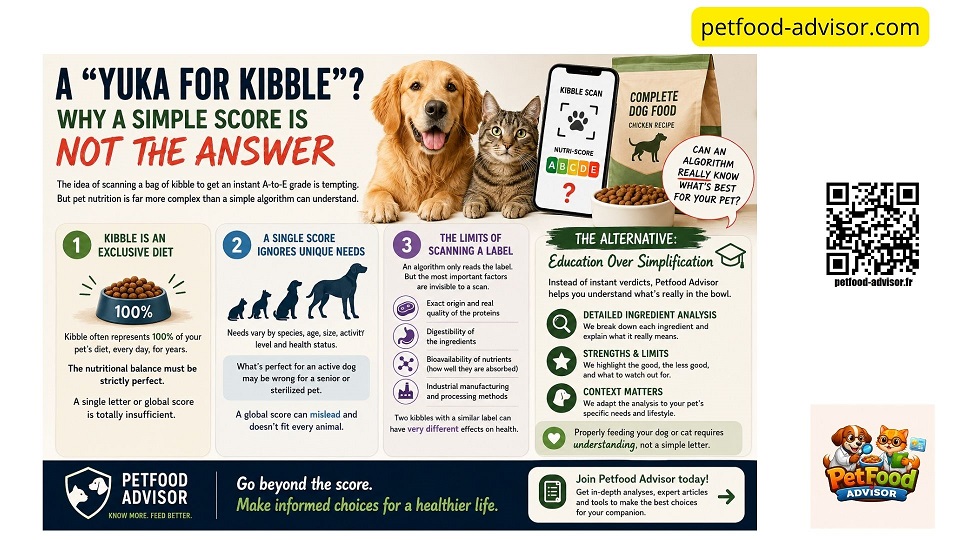
The idea of a “Yuka for kibble” is highly appealing and responds to a strong demand from consumers. Faced with an increasingly complex market and labels that are hard to decipher, being able to scan a bag of pet food to instantly get a clear grade or an A-to-E ranking seems ideal. However, applying the principle of simplified grading to animal nutrition has major limitations and is not actually a reliable solution.
Here is why creating a true “Yuka for kibble” is fundamentally flawed:
1. Kibble is an Exclusive Diet
The success of the Nutri-Score and apps like Yuka in human nutrition relies on the fact that we eat a varied diet. A poorly rated product can easily be balanced out by healthier choices during other meals in the day. Conversely, kibble very often constitutes 100% of a pet’s diet, every single day, for several years. This exclusive diet requires a strictly perfect nutritional balance that is impossible to summarize with a single letter or a global score.

2. A Single Score Ignores Unique Needs
Attempting to condense nutritional complexity into a universal score is misleading. Unlike humans, the needs of dogs and cats vary drastically depending on their species, age, size, activity level, and health status. A recipe that might be considered “excellent” for a highly active dog could be completely inappropriate for a sedentary, sterilized, or senior animal. Therefore, a global score risks unfairly penalizing foods that are perfectly adapted to specific profiles, or conversely, falsely reassuring an owner about a product that is unbalanced for their specific pet.
3. The Limits of Scanning a Label
An instant grading algorithm relies entirely on what is printed on the packaging. Yet, the most essential indicators of a kibble’s quality are often invisible to a simple scan. A scan cannot evaluate:
- The exact origin and real quality of the proteins.
- The digestibility of the ingredients.
- The bioavailability of the nutrients (how well they are absorbed by the body).
The industrial manufacturing and processing methods, which significantly influence the quality of the finished product.
Two bags of kibble with a very similar composition on paper could get the same score on an app, yet have radically different impacts on your pet’s health in practice. A global score forces invisible compromises, mixing proteins, carbohydrates, and additives into an ultimately approximate grade.
The Alternative: Education Over Simplification
Instead of giving in to the temptation of shortcuts and the illusion of mastery offered by simplistic grades, platforms like Petfood Advisor propose a more educational and nuanced approach.
Rather than distributing instant verdicts like “good” or “bad,” their goal is to offer a structured reading of the products: highlighting the strengths and limits of each recipe, providing a detailed analysis of the ingredients, and contextualizing the food based on the specific needs of the animal. Properly feeding your dog or cat requires a comprehensive understanding that can never be replaced by an opaque algorithm or a simple letter