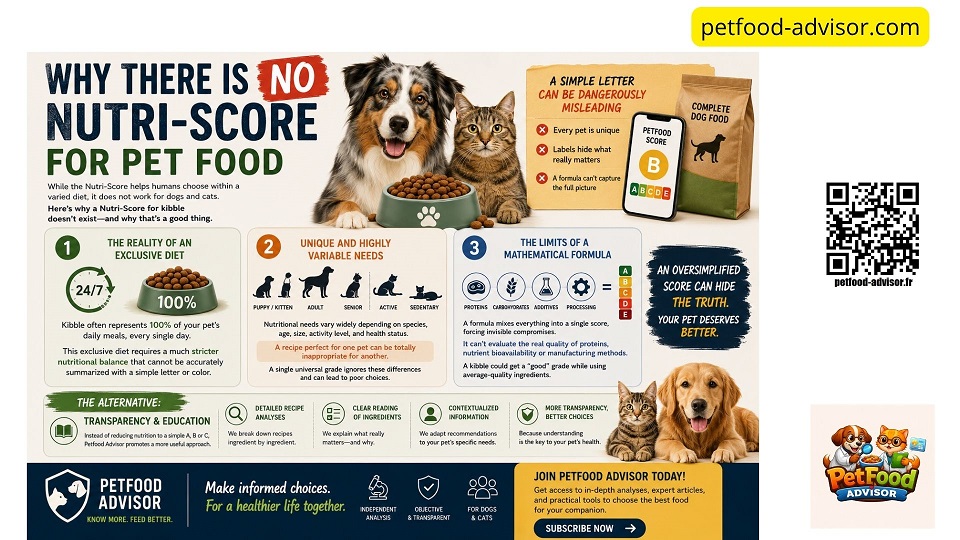
While the Nutri-Score has become a familiar benchmark in human food aisles, an equivalent for pet food remains nonexistent. Although a simple A-to-E “petfood-score” seems highly appealing, it relies on a simplification that fails to address the reality of animal nutrition. Here is why standardizing a Nutri-Score for kibble is fundamentally flawed:
1. The Reality of an Exclusive Diet
The human Nutri-Score is designed to help consumers make quick choices within a varied diet, where a poorly rated product can easily be balanced out by healthier meals throughout the day. However, this reasoning does not apply to pets. Kibble is rarely just a complementary food; it often constitutes 100% of a dog’s or cat’s daily meals. This exclusive feeding requires a much stricter nutritional balance that is impossible to accurately summarize with a simple letter or color.
2. Unique and Highly Variable Needs
Unlike human food, the nutritional needs of dogs and cats vary drastically based on their species, age, size, activity level, and health status. A specific recipe that is perfectly formulated for a highly active dog could be completely inappropriate for a sedentary or sterilized animal. Attributing a single universal grade ignores these specific profiles and creates an illusion of simplicity that can lead owners to make bad decisions for their pets.
3. The Limits of a Mathematical Formula
The human Nutri-Score relies on a calculation that balances favorable and unfavorable elements, such as proteins, fibers, sugar, and salt. In pet food, this logic quickly hits its limits. Mixing proteins, carbohydrates, additives, and manufacturing processes into one global score forces invisible compromises. A simplified score fails to evaluate crucial factors like the real quality of the proteins (animal vs. vegetal origin), nutrient bioavailability, and industrial processing methods. As a result, a kibble could receive a “good” grade while using average-quality ingredients, making a pet Nutri-Score fundamentally approximate.
The Alternative: Transparency and Education
Because a global score risks masking crucial information or misleading consumers, platforms like Petfood Advisor advocate for a more demanding and useful approach. Instead of reducing a complex nutritional reality to a reductive A, B, or C, they offer detailed analyses of recipes, clear readings of ingredients, and contextualized information based on the animal’s specific needs. Ultimately, properly feeding your companion requires real understanding and transparency, not just a simplified letter grade